Monday, 18 September 2017

Poems in the Air: Day 1


21km Stonehaugh – Watergate – Whitchester – Snabdaugh – Greenhaugh

We had been planning on visiting the Poems in the Air ever since hearing about the project.  It involved walking to specific places within the Northumberland National Park following a route on a phone app.  On arriving at the end point, the app would unlock a poem, written and read out by Simon Armitage, about the particular location.  It was an area I was unfamiliar with, which made it an interesting proposition.  There are six sites and at first I tried to plan a route that would link all locations in a continuous walk.  However, the distances between them made this impractical so I settled for three one-day walks, each one linking two poems.  Jill would come along to visit the poems too, using the short walks described by the app, and driving between them.  She would also act as my lift from my walk’s end to the place we were staying that night.

The first stop was a long drive to the back of beyond, a village (of sorts) called Stonehaugh, which mostly seemed to consist of campsites and groups of holiday chalets.  The proximity of the Pennine Way perhaps explains this.  The car park, with its handy composting toilet, was empty when we arrived, though another car soon turned up.  Other people visiting the poem, I wondered, but no, they went a different way.

It didn’t take long for us to lose the way, being a bit casual about the directions.  We ended up at an apparent dead-end in a wood.  It was here I finally checked where we were to discover we had gone astray.  Luckily there was a way of sorts, though hardly a path, stumbling over a cleared line through the plantation.  It was drizzling intermittently which meant the long undergrowth soon soaked our legs and went through our boots.  After dodging brambles and nettles, and clambering round a fallen tree, we made it back to the official route.  This didn’t get any better as it twisted and turned through more overgrown vegetation, over muddy, narrow paths.  It was slow going, which meant the clouds of flies danced around our heads and crawled over any exposed skin.  Thankfully they weren’t the biting kind.

After a slippery descent and a climb over a stile, we suddenly came to the first poem location, the Weaver’s Cottage.  It was a very dilapidated ruin, slowly turning back into woodland, perched a little above a churning, dark pool in the river of Warks Burn.  As advertised, the phone app burst into life and started playing Armitage’s soothing tones.  The poem talked about the line of families who had lived in the valley, stretching along the river to pool at this point.  Somewhere downstream were ‘stags and hens’, hinting at future populations.  The poem also described the setting, with a mossed-over hearth, a holly tree bearing down on the gable wall and three tall spruces between the cottage and the river.
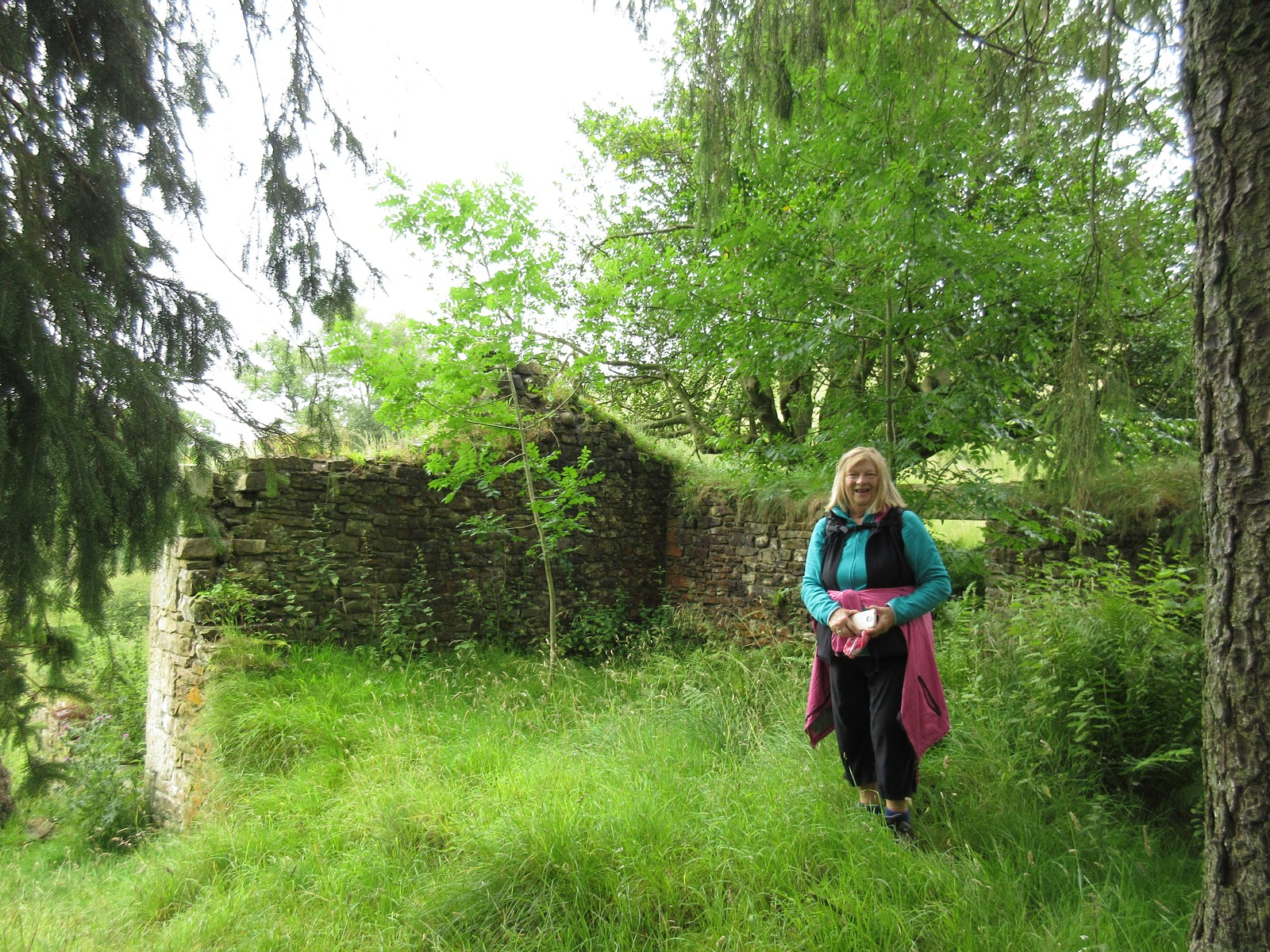

Jill turned back after this, using the proper route this time but finding it little better.  I climbed up and along to join the Pennine Way north for a stretch.  The paths were decent but I was surprised by a loose dog at Linacres that crept right up behind me before unleashing its bark.  Just beyond this I regretted my decision to keep on to Hunt Hill before turning to Watergate.  The ‘path’ was just an area of cleared forest.  Like earlier, I had to trip over stumps and fallen timber, along boggy, wet grass.  The flies, without a breath of wind, clustered around my head again and I flapped vainly at them, waving my hands around like Mad Jack McMad.  When I finally reached the far side and a proper path I was wet and exasperated.  A sign on the gate hilariously suggested the swamp I had just navigated was a bridleway.

After this I hit a road, which was some relief, though the shelter of trees meant I hung onto my gang of flies until the gentle climb took me onto open ground.  I popped up to Watch Crag to bag the trig point before continuing over Whitchester Moor.  The path disappeared again into a huge zone of tall grass and tussocks.  Again it was slow going and hard to see where the path, if it existed, lay.  After much grumbling I made it to the track up to Whitchester farm.  It felt like a strange, isolated place, given the arduous approach I had made.  A Wild West farmstead, up on the plains, a long way from civilisation.  It was deserted as I crossed the yard, not even a dog barking.  Mud and detritus was scattered everywhere, as if it had been ransacked by an invading army.  I passed through quickly, keeping my head down.


I lost the path again getting to Snabdaugh and was thankful again to find a road.  House martins perched on the phone line by Cliftonburn Bridge until a Royal Mail van scattered them.  I was getting near the next poem, a little way beyond the River Tyne.  A variety of pleasant paths took me to the edge of some woodland by Tarset Burn.  Checking the app I found the poem was unlocked.  It was called ‘Hey Presto’ and was a series of similes for the sight of a kingfisher flashing along the river.  Each line took the form, ‘I give you the X of the kingfisher.’  From ‘the azure streak’ through ‘the ambulance light reflected in the blank windows of the charity shops on the esplanade’ to a final admission that there is nothing to compare it to, ‘I give you the kingfisher-like kingfisher of the kingfisher.’

With a grin, and a raised eyebrow at not finding Jill, I made my weary way uphill to Greenhaugh.  It’s a very pretty village, built of low, cream-coloured stone buildings.  The pub we were meeting in, the Holly Bush, was just another building in a terrace.  Inside the small, dark bar I found Jill and a couple of local blokes.  It was a relief to sit down and drink a very good pint of Nel’s Best (famously pulled by Prince Charles, by the looks of a photo above the fireplace).  Time was getting on, so we sadly left it at that and headed to Rothbury.

In Rothbury we had pleasant rooms in the Springfield guesthouse.  We didn’t hang around there long before following the landlady’s recommendation of going for dinner at the Queen’s Head Hotel next door.  The specials were fishy – whitebait then hake for me, squid then salmon for Jill – and were very good indeed.  The kitchen seemed a bit chaotic.  Jill asked for a sparing amount of butter on her salmon, but it came swimming.  A girl at the table next to us asked for lasagne with vegetables on the side, and got vegetable lasagne.  An Italian family got beans with the kids’ meals when they asked not to have them.  The barman was apologetic and accommodating.

Tired from a long day, we were in bed early.

Saturday, 8 July 2017

Taking on Foinaven


Over the previous night’s dinner, a plan to climb Foinaven had been mooted.  Jesper and I had been circling around it the last three days, admiring its grey bulk and steep flanks, and, despite the efforts of the last three days' hard walking, we couldn’t resist coming along too.  I fuelled myself with granola and waited for Dave C, our transport man, to arrive.  He was there on cue so we drove down to Keoldale to meet Heather and Dave W.  The forecast warned us of rain later but for the time being it was dry, albeit with low cloud shrouding the summits.  If the weather stuck to the forecast, that cloud should lift later in the day.

The first part of the walk was a long, if easy, slog along an estate path.  The sun was threatening to appear and, anxious to avoid making my shiny red nose any redder, I slapped some cream on.  A Land Rover passed us on the track and I noticed a cage in the back, inside which perched a serene-looking raven.  I could only think it was an injured bird they were intending to release somewhere, but it seemed a long way to go just to find somewhere to set it free.  A little while later the car came back the other way.  The raven was still in its cage in the back.  Perhaps it was a pet they were taking out for a scenic tour.
After the level track, we finally turned off uphill.  Dave W led the way, doing his best to find a route despite there not being much of a path to speak of.  We climbed steadily up to one corrie, Coire Duaill, then more steeply up to a second, Glas Coire Granda.  The going got even steeper, and more rocky, as we then made our way onto the ridge at Bealach nan Carn.  Amongst the boulders and not much below the cloud base – stubbornly unlifted – we waited a short while for a struggling Jesper to join us.  He admitted he was finding it hard work and that, with the low cloud, his motivation wasn’t that high.  Nevertheless, we pushed on.
The next section showed us what steep really meant.  It was wet and grassy, with rocks and boulders sticking out here and there.  You didn’t have to lean very far forward to find yourself with your nose to the slope.  It was precarious with dodgy footholds and a long drop behind.  Heather found it very trying, especially with her particular bugbear of misty ascents, and Dave W had to keep up a constant litany of encouragement to keep her going.  Dave C helped with distraction tactics, talking of life in York and how planning for the future is all hot air when you don’t really know what’s coming next.  Jesper, somewhere below us, had to fend for himself.

Just below the first summit, Ceann Garbh, we paused again amongst rocks to let Jesper catch us – in the mist it would have been crazy to split up.  As a full party, we climbed onto the main ridge and felt the full blast of the wind.  It battered me like a like a heavyweight, pushing my feet and legs around as I tried to step through the boulder field.  As we started the ascent to the main summit I could feel my fingers going numb in the wind-chill so I stopped to get some thicker gloves out, frantically fiddling at zips and buckles with frozen fingers.  Material flapped about, straps whipped my face, Velcro attached itself to everything except the surface it should.  It took an age to achieve this simple task, all the while being ripped into by the murderously chilling gale.
Strapped up and better insulated than before, I continued the march uphill, slightly behind the others.  It wasn’t a long climb and we were soon together at the top.  We tried to pose for summit photos while staggering around in the unrelenting tempest then decided it wasn’t a place to stop long, although there was a tiny area behind a big cairn that gave a surprising amount of shelter.


The route we were following was from the Walk Highlands website.  The return journey wasn’t the same as the outward one, so we could avoid the precipitous route we took upwards, but didn’t present a very easy descent.  It dropped off the side of the ridge at a seemingly arbitrary point and turned down through large, unstable boulders, before a jink left to avoid some crags.  Jesper wasn’t very impressed with the route though we all made it off the steep bits safely.  The final section was another long walk, this time over pathless moorland, studded with bogs and lochans.  The advertised rain arrived here, first as drizzle, then imperceptibly heavier.  Around the far side of one lochan we found a hind staring at our approach, not particularly bothered about us but wary.  She moved a little further away before standing her ground and watching us pass.

By the time we regained the road we were dripping wet in the remorseless rain.  I didn’t exactly question my sanity but I wondered how I would answer the question, ‘Did you enjoy your walk?’  It would be hard to say it was enjoyable, exactly – with the steepness, the cloud, the wind and the rain – but I would hesitate to say I didn’t enjoy myself.  You could say it was a challenge overcome or another Corbett ticked off, but those pretexts don’t seem to do.  There’s something about being involved with the mountain, in whatever mood it’s in, perhaps to do with Nan Shepherd’s (via Rob Macfarlane) walking ‘into’ the mountain (as opposed to ‘onto’).  The other day on Arkle, when the stormy weather had cleared and we were given a glorious day, again I didn’t think about having ‘conquered’ the hill, but that we had been allowed our time on it in comfort and safety by some sort of grace.  We didn’t come to claim the hill as ours, we were just granted our time there, to experience it, to get to know it, to bear witness to its gravity, its geology and its beauty.

Monday, 26 June 2017

Macmillan Lake District Mighty Hike 2017


Macmillan organise a number of ‘Mighty Hikes’, long-distance single day walks, around the country but this was the first in the Lake District.  Over 1000 people had registered for the 25 mile trek, including me, my colleague Pete and another group from the Manchester office.  We were set off in waves of 200 or so every half hour.  Under cloudy skies, with a sense of nervous expectancy, at 8am we were off.

 The first part of the route was on level ground alongside Derwent Water.  A long stream of green tee-shirt-clad walkers stretched ahead of and behind us.  The clouds cleared and by the time we reached the first rest stop at Borrowdale, it was very warm.  We found a shady spot to eat the croissants and pastries provided by the organisers before rejoining the route.  ‘How’s it going?’ I asked Naomi from MAN34 as I caught her up in gently sloping valley of Langstrath.  ‘Absolutely flipping awful,’ she replied (approximately).  An honest assessment, though there were still 15 miles to go.
Shortly after this was the big, hard climb of the day up the Stake Pass.  It was tough in the heat but a good path.  At the top I lay back on the grass in the sun and rested my eyes.  Unfortunately this caused the marshal to panic, thinking that I had collapsed from exhaustion.  I reassured her I was only having a kip and complained that she had interrupted my sleep.
Lunch was in a marquee in Langdale and it was an excellent spread of salads and cakes (of which I probably ate too many).  There was also the chance to refill water bottles, as there were at each stop, and to try some High5 energy drink (jury still out on that one).  Pete and I had a quick chat with the other Manchester walkers before moving on again.
The walk out of Langdale was hot and airless.  Higher up at least we had had a bit of a breeze to cool us down.  We passed some kids in the river at Chapel Stile and would have loved to have swapped places.  There was another climb over into Little Landgale and the effort was telling in our legs.  The paths would beautifully through fields and woods but the afternoon stop couldn’t come soon enough.  Again we found some shade and tucked into Freddo and Fudge bars.  People were easing their boots off for some relief, revealing plasters galore.  ‘Is that it for climbs?’ one girl asked.  ‘Just one more,’ I replied, more or less truthfully.
The climb went steeply up to Loughrigg Tarn then kept on agonisingly until finally we saw a glimpse of Windermere.  We started descending, then heard the crowds and then found ourselves being applauded over the finish line to receive our medals and a glass of fizz.

It had been a brilliant day: well organised, excellent route, good company and camaraderie.  Along the way members of the public had encouraged us and said what a good cause we were walking in aid of.  So far Pete and I have raised £1355, which is absolutely amazing.  I would definitely enter a similar event and would recommend others to do the same.